Somewhere in the last decade, attachment theory escaped the research literature and became content. You've met the escaped version: four types with familiar names (secure, anxious, avoidant, fearful-avoidant), a quiz to sort you, and a diagnosis for your ex.
Here's our position, since a page that won't commit isn't worth your scroll. The research behind the styles is real, and it's some of the most heavily studied territory in psychology. The quiz version is that research flattened into a personality test it never was. What the science actually found is more useful, and honestly, it's better news.

Where the styles come from
John Bowlby was a British psychiatrist watching what separation did to young children after the Second World War. His claim, radical then, was that a child's bond to a caregiver is a biological system in its own right, not a by-product of feeding. Under threat, a young mammal seeks its protector. Everything else waits.
Mary Ainsworth gave the idea its evidence. Her "strange situation" studies watched how infants used a parent as a base, and the telling moment wasn't the separation. It was the reunion. Some children sought comfort and settled. Some clung and couldn't settle. Some looked away as if nothing had happened, while their stress physiology said otherwise. (A fourth pattern, disorganized, was named later, for the children whose strategy never settled into one shape at all.)
The leap to adulthood came in 1987, when Cindy Hazan and Phillip Shaver asked whether romantic love runs on the same system. Their first instrument was, charmingly, a love quiz in a local newspaper. The answer has held up through decades of far more careful work: broadly, yes. The system that once oriented you toward a caregiver now orients you toward the people you love.
So the familiar names started as descriptions of behaviour in a laboratory. They were never meant to be sorting-hat houses.
Two dials, not four boxes
This is the part the quiz version skips, and it's the most useful idea on the page.
When researchers built serious measurement for adult attachment (the workhorse is a questionnaire lineage called Experiences in Close Relationships), four categories are not what fell out of the data. Two independent dials did, and everyone sits somewhere on both.
The first dial is attachment anxiety. When closeness feels unsure — the unanswered message, the distracted mood — how loudly does your system ask are they there for me? Turned up, the question is loud, and reassurance is what quiets it. Turned down, it barely comes up.
The second is attachment avoidance. How much does closeness itself cost you: depending on someone, being depended on, being fully seen? Turned up, intensity pulls you toward self-containment, and space is what settles you. Turned down, closeness is cheap to spend.
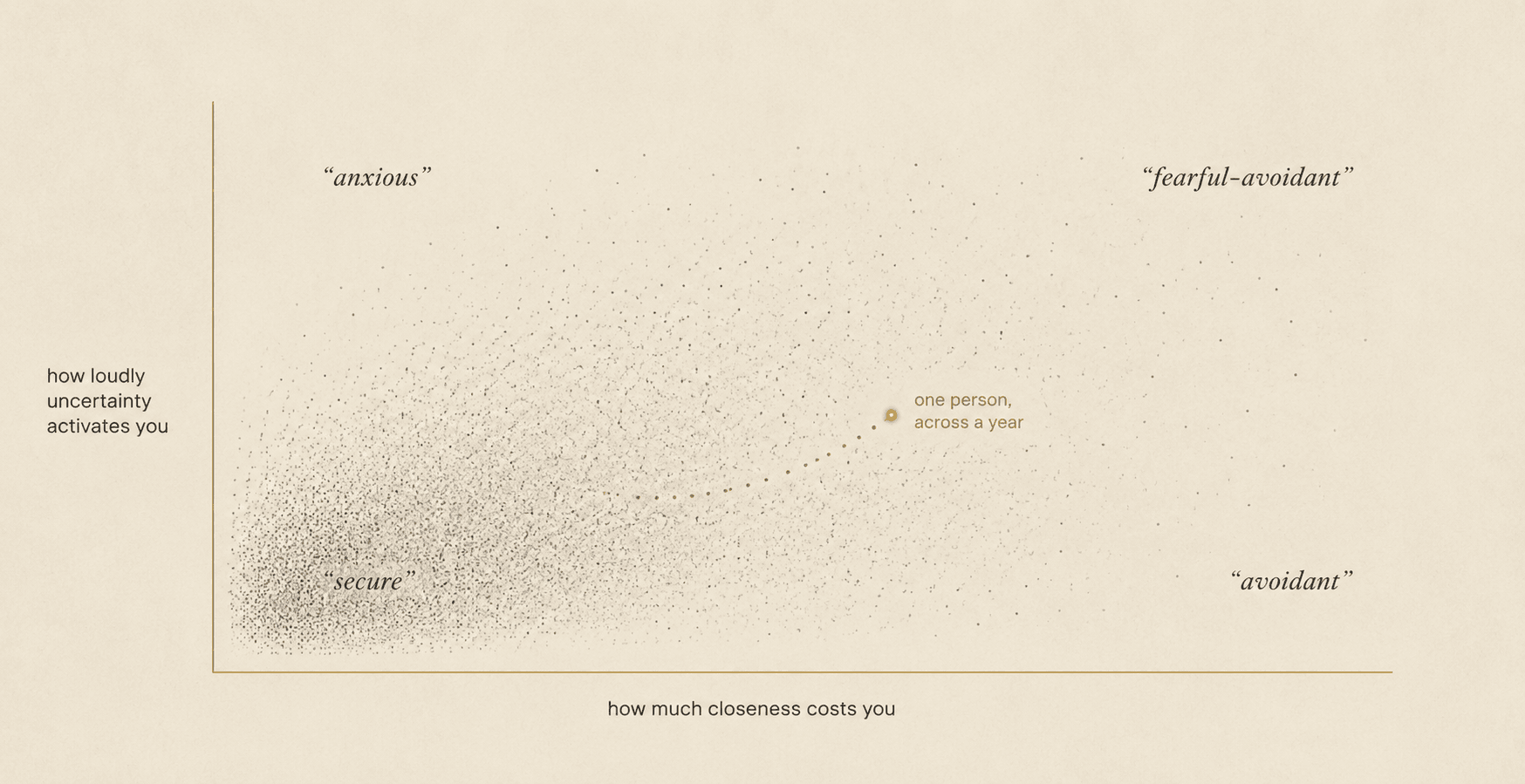
There's a technical literature on whether attachment forms natural categories at all, and its answer is reasonably clear. The distributions are continuous. There's no cliff edge in the data where one neighbourhood ends and the next begins.
Calling yourself "an avoidant" is like calling yourself "a tall." It marks where you sit on a continuum, and it invents a species while doing it.
What the four names actually mean
With that said, the names are worth knowing, because you'll meet them everywhere and most of what's said about them is sloppy. Here's each one relocated onto the dials, with what living in that neighbourhood can look like from the inside.
"Anxious"
preoccupied, in the research
The uncertainty dial is up, and closeness itself is welcome. So the discomfort comes out as reaching, and the are they there for me question gets loud well before there's evidence either way.
- Re-reading a short reply for tone
- Needing the repair tonight rather than tomorrow
- Reading a delay as an answer
"Avoidant"
dismissing, in the research
Closeness costs something here, and space is what brings the system back down. Pressure to engage arrives as more pressure, which is why this one gets misread as not caring, when the person is often working quite hard.
- Going quiet partway through an argument
- Handling it alone first and talking later, or not at all
- Feeling crowded by a bid you'd have welcomed on a different day
What secure actually means
Both dials down. It isn't a personality grade, and it isn't the absence of worry — that's the version the quizzes sell, and it makes a fairly ordinary state sound like an achievement. It means uncertainty doesn't take over the room, and accepting closeness doesn't cost much. Most people spend more time here than they'd guess.
- The hard sentence can get said without it becoming a threat
- Reassurance can be offered, and also taken
- Repairs mostly land
What happens when both dials are up
filed by the internet as "fearful-avoidant," sometimes "disorganized"
Wanting closeness intensely while finding it costly, at the same time. It tends to show up as a reach followed by a retreat, and of the four names this is the one most often delivered like a diagnosis. It's a position on two dials, and it's a common human place to stand.
- Reaching, then pulling back when the reaching works
- Wanting badly to be known, and dreading being known
This is also the least settled of the four. The infant pattern called disorganized and the adult one called fearful-avoidant get spoken of as the same thing; the research hasn't established that they are.
Nobody is secure at 2am
What you have is a position, not an identity. And the position moves more than the vocabulary lets on.
People reliably describe different patterns in different relationships. More settled with this friend, more activated with that parent, something else again with a partner. The same person shifts across seasons of life, under stress, with grief, with new safety. Nobody is secure at 2am waiting for a reply that usually comes by ten. Nobody is avoidant while their kid plays in the next room and everything is fine.
The behaviours the styles describe are strategies. Reaching toward someone and pulling inward are both ways of trying to stay safe in connection, learned wherever they once made sense, and most people can find both in their own history depending on the person, the stakes, and the day.
Every human is unique, and nobody fits neatly in a box. Given the right circumstances, any of us can show any of these patterns. So the interesting question was never which one are you.
The better question: what's your usual first move when connection feels uncertain, and what's it like to be on the other side of it?
The loop
That second half matters because attachment patterns don't operate solo. They interlock.
The most-documented destructive cycle in couples research runs like this:
- One partner feels distance and reaches: asks, checks, protests, pursues.
- The other feels the pressure and pulls inward to settle.
- The pulling-inward reads as more distance.
- So the reaching gets louder, the withdrawing gets deeper, and around it goes.
Researchers call it pursue–withdraw. If you've lived it, you don't need the terminology.
Each person's safety strategy is feeding the other's alarm, which is why the useful thing to name is the loop. Neither move is the villain. Couples who get somewhere with this pattern get there by seeing the circle they're standing in together, not by winning the argument about whose strategy is the pathological one.

What the labels cost
A type, deployed mid-argument, is name-calling with a bibliography. "You're so avoidant" doesn't describe your partner. It files them, and people can feel the difference between being understood and being filed.
The labels also flatten things that deserve better readings. Some people process feelings slowly, or need words to arrive later than the moment wanted them. That includes many neurodivergent people, whose quiet is wiring, not wound, and who spend a lifetime having it misread as coldness. How closeness gets expressed is also shaped by family and culture in ways no American questionnaire was normed on. Reading every inward move as "avoidant attachment" gets these people exactly wrong, with a confidence the science never authorized.
Self-typing has the same problem pointed inward. People usually type themselves from their worst season or their most painful relationship, then treat the result as their operating system. And a type, once believed, becomes a script. I can't help it, I'm an avoidant is the theory used as a lid, when the whole point of understanding a pattern is that it's a lamp.
Styles move
Here's the finding that deserves the fame the four types got instead: attachment positions are only moderately stable across a life.
They drift in longitudinal studies. They shift with experience, inside relationships where reaching gets met, where conflict gets repaired instead of repeated, where distance stops meaning abandonment and closeness stops meaning engulfment. The clinical literature has a name for arriving at security the long way: earning it. The mechanism is unglamorous. Enough experiences that contradict the old expectation, until the nervous system updates its forecast.
Not overnight, and not by reading. (Reading about your patterns rewires them about as much as reading about swimming gets you across a lake.) What moves the needle is practice: noticing your own first move when connection feels uncertain, and sometimes, carefully, with the right person, doing the unfamiliar thing instead.
Where the science stops
A few honest limits, because this page would be cheaper without them.
- Most adult attachment research runs on self-report. It measures how you describe yourself, and the people most affected by these patterns aren't always their own best narrators.
- The effect sizes are modest. The dials predict tendencies across many people, not the outcome of your relationship.
- The foundational samples were heavily Western and university-adjacent. How the patterns express across cultures is genuinely under-studied.
- Attachment doesn't explain everything with feelings in it. Sometimes the distance is the job, or the grief, or the day. A framework that explains everything has stopped being information.
How we hold it here
Inside Conscious Connections, this science shows up with one deliberate absence: we never assign you a type. Not from a quiz, not from your answers, not from your behaviour.
What we do instead follows everything above. We ask how familiar the vocabulary is, so it's only used with you if it will land. We ask how you'd describe your own patterns, in your own words. And we ask the two dial questions directly, as sliders you set yourself: how much closeness and reassurance you need when things feel uncertain, and how much room you need when things get intense. Self-description, held as context, revisable whenever your answer changes.
Answer from whatever feels true. If a box ever helps, borrow it. Just don't move in.
Something here off, broken, or not sitting right? Tell us — a person reads it.
People and books appear here because we’d recommend them with nothing to gain. Some may partner with us over time; no one is listed because of it.